
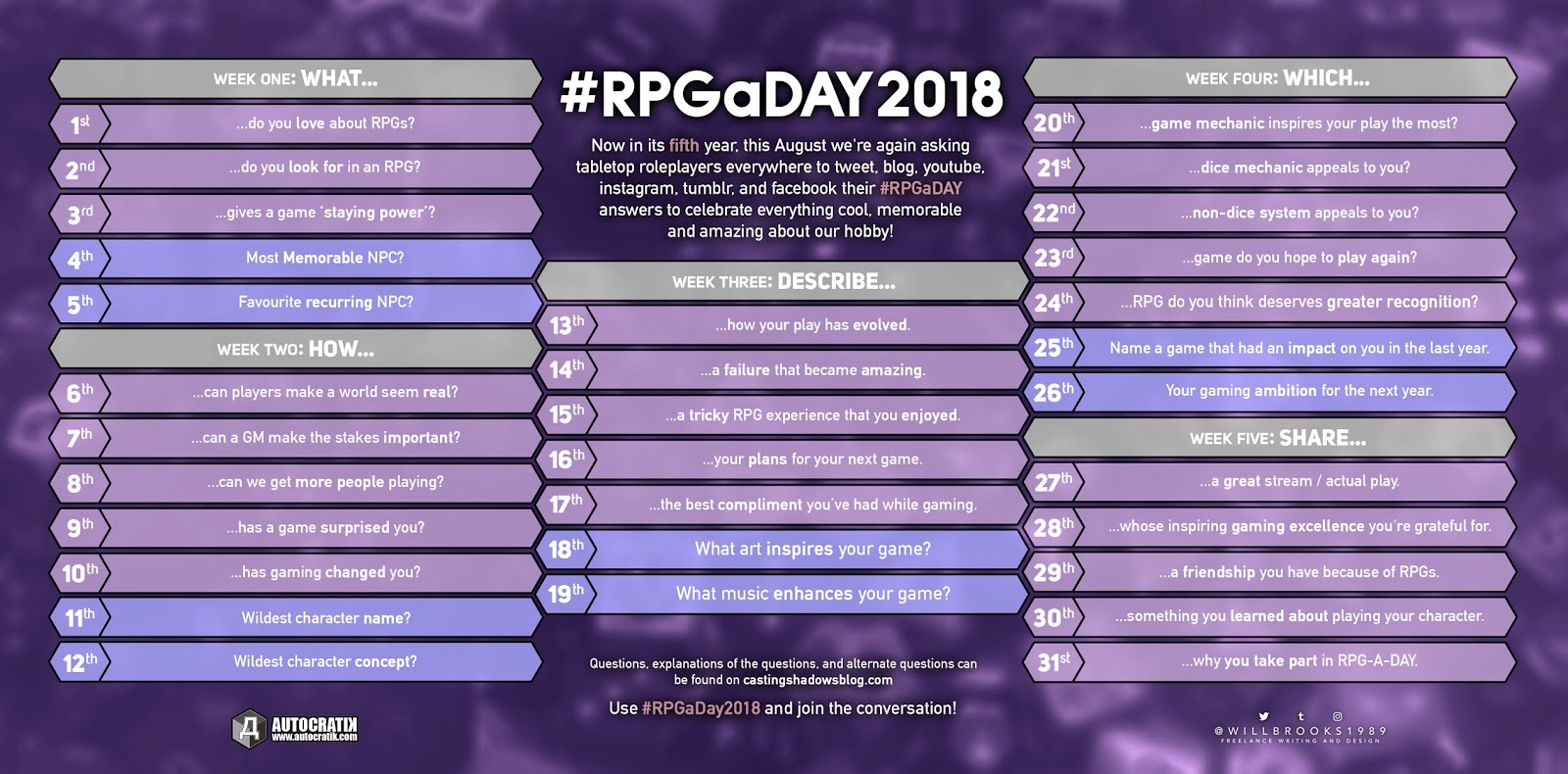
RPGaDay2018, Day 23 — Which Game Do You Hope To Play Again?

Which game do you hope to play again?

In all honesty? Any of them.

As I’ve said before, things have been so hectic for such a long time, I have not been able to be in a regular game for literally years. This is exacerbated by most of my good friends being spread out all over the globe (necessitating getting familiar/comfortable with online play tools, which I’ve never used before).

…and a bad side-effect of becoming a fan of some of the streaming RPG web series that have launched is that I have become wracked with seething envy over the possibilities of what can be created by playing a great game with a group who is utterly invested in their characters and the process: an ideal which (let’s be frank) is seldom achieved.

Well crap. This turned maudlin.

I blame the rain.


RPGaDay2018, Day 22 – What Non-Dice System Appeals To You?

What non-dice system appeals to you?

Recently, I’ve fallen in love with a system from a couple of games that are about a decade old, that I’ve only just discovered.

It’s the system that powers Omnihedron Games’ Napoleonic adventure RPGs, Duty & Honour, and Beat To Quarters, which they’ve made available in PDF as a “Name Your Price” release (apparently while they work on a new edition.)

DUTY & HONOR is basically “Sharpe’s Rifles, The RPG,” and BEAT TO QUARTERS is “Horatio Hornblower.”

Both of them use a system based on traditional playing cards. The cards are used as randomizers, capable of generating everything from a character’s background to their military experience, and also as the core Test system, which works as follows:

1) You state the intent of the Test — everyone agrees what’s happening in the test, and what the consequences will be if the Test is won or lost.

2) You take the value of the skill being used, modified by any traits, equipment or your character’s reputation). This gives you the number of cards which will be in your pool. The GM determines the pool for the opposition.

3) The GM overturns one card from their deck, which is the Card of Fate, that all participants in the test will test against.

4) You turn over cards from your deck equal to your pool.
• If the card is the same suit as the Card of Fate, that’s one success.
• If the card is the same number as the Card of Fate, that’s one Critical success.
• If the card is the same card as the Card of Fate, that’s one Perfect success.
• If the card is a Joker, it’s Wild and can represent any card you like.
• If the card does not match suit or number, it’s a failure.

5) Determine the victor. Success is determined by who has the most Perfect successes, and then Critical successes, and then successes.

6) You then resolve the intent of the test, return all cards to the deck, and shuffle.

I think this system is great, because of the ease and elegance, the wide array of possible results, and the fact that the traditional playing cards make it feel 19th century, in comparison to polyhedral dice. Pick it up and check it out!


RPGaDay2018, Day 21 – Which Dice Mechanic Appeals To You?

Which dice mechanic appeals to you?

Honestly, as long as the mechanic falls into my “emulative & elegant” rubric, I’m good with it.

That said, I will admit to a long-standing love, born mostly of nostalgia (but not entirely — I find them emulative & elegant as well), of two dice systems: Percentile (my first, through Top Secret, and via my favorite emulative system, James Bond 007), and the D6 System (bunch of D6s, including a Wild Die for extra potential — in it’s best form in West End’s Star Wars).