
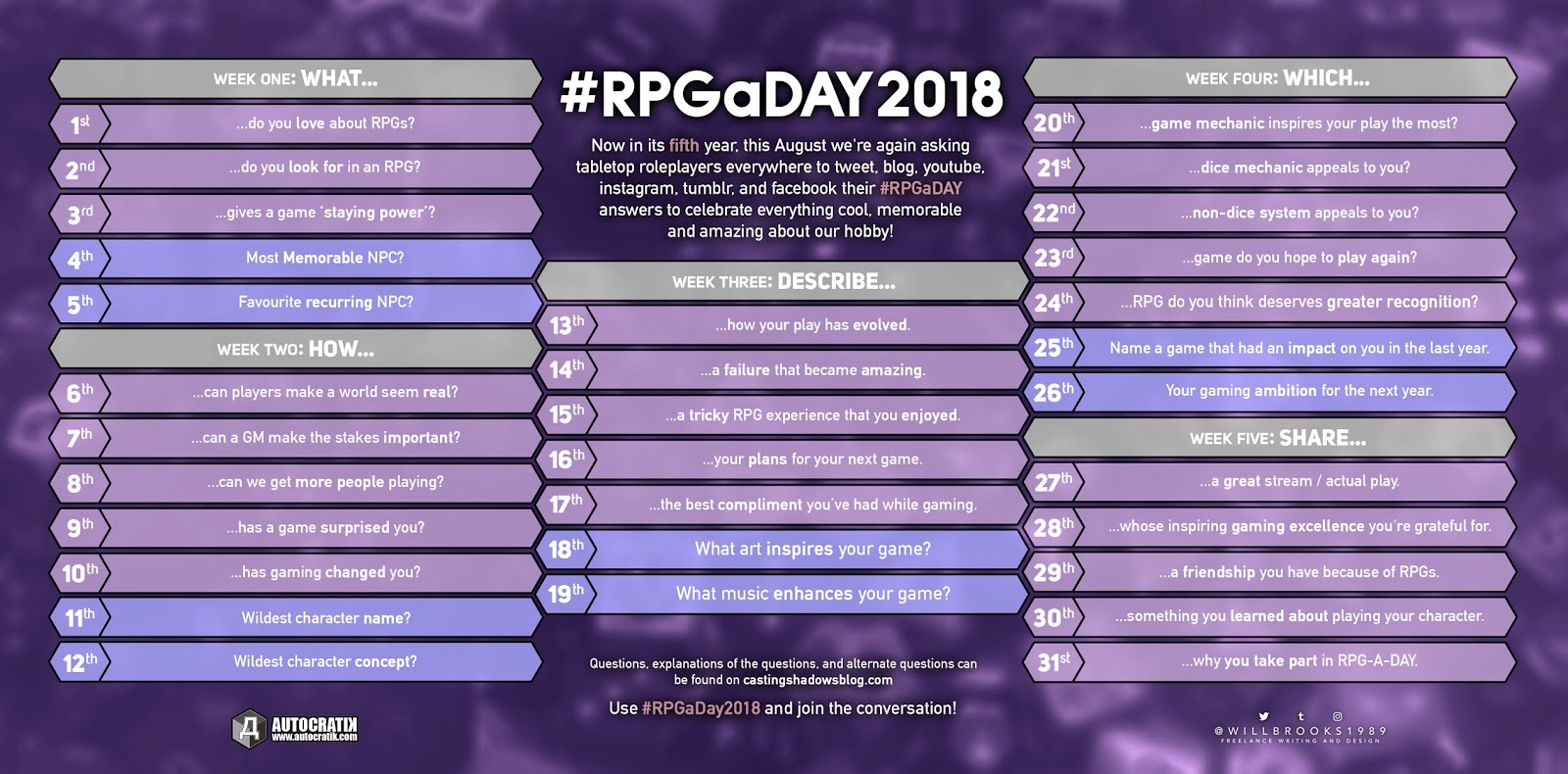
RPGaDay2018, Day 14: Describe a Failure That Became Amazing.

Today’s question: Describe a failure that became amazing.

Interestingly enough, this allows me to repeat a story that first appeared in #RPGaDay2014, day 13: “Most Memorable Character Death.”

In the mid-80s, my best friend and I sat down to play a game of Hero Games’ DANGER INTERNATIONAL. It was a Champions spin-off that was for playing un-powered action hero types: spies, private eyes, cops. soldiers, that kinda thing.

Dave (my best friend) was going to run me through a game where I was playing a DEA Agent. I was pretty excited about this, because in our games, I was almost always the GM, so getting a chance to play was great. We spent quite a long time creating my agent (remember: Hero System), and started to play.

David set the game in Miami, and had me looking for my partner, who had disappeared while on an undercover operation. No sooner had we started playing, than he partnered me up with representatives of the local police: Sonny Crocket and Ricardo Tubbs! (Yes, we were both fans of MIAMI VICE, which was at the height of its popularity at the time).

Rumor had it that members of the cartel that my partner had been investigating were holed up in a stilt house, out on the water near Biscayne Bay. So of course we hopped in the speed boat, and one Jan Hammer musical montage later, we arrived at the house. We split up, with Crocket and Tubbs taking one side of the house, and me the other. I neared the door, and kicked it in…

…and caught a face full of claymore mine. The door (the whole house, in fact) was trapped. Nobody was there. KA friggin BOOM. One unreasonably large handful of d6 damage dice later, my DEA agent was dead.

What we had thought was going to be a story about the exciting adventures of a rough-and-ready DEA agent, turned out to be only the motivational death in the pre-credits sequence of a Miami Vice episode.

This definitely qualifies as a “failure that became amazing,” because we still remember and laugh about this, 30 years later.

I hope Crocket and Tubbs got the bad guys in the end.


RPGaDay2018, Day 12: Describe How Your Play Has Evolved.

This week’s questions are all “Describe…”, so I suspect that these might be a bit more involved than the usual short answers.

Today’s question is “Describe how your play has evolved.”

I’ve been playing for nearly 40 years now, so to go into detail on that would take far more than I’m willing to expend on this (and would probably only be of interest to me, in any case). That said, I think I can organize my evolution of play into four general ‘eras.’

• The Genre Polymath: As I’ve mentioned before, I started with TOP SECRET, and six months later, D&D. Over the next few years, I devoured any RPG that I came across — I bought and read more games than I ever managed to play — and I played a lot. STAR FRONTIERS, GAMMA WORLD, BOOT HILL, TRAVELLER, MARVEL SUPER-HEROES, UNIVERSE, DAWN PATROL, etc. When I did play, we stuck to the rules as written — no fudging of die rolls, no real consideration of story over mechanics, etc.

• The Emulator: It’s pretty easy to mark the start date for this ‘era’ — 1983, with the release of Victory Games’ JAMES BOND 007, a game that opened my eyes to the fact that rules could be designed to be more than just mathematical resolution of events, but could actually be designed to emulate the feel of a genre. I found myself drawn to systems that took this approach, and my games began to emphasize the tone and trappings of a setting far more than before. Other games I played during this period were FASA’s STAR TREK and DOCTOR WHO, Chaosium’s CALL OF CTHULHU, and I brought the lessons of emulation back with me into games I’d played in a less-emulative fashion previously.

• The Storyteller: This is more of a culmination of the above ‘era” — with the arrival of VAMPIRE: THE MASQUERADE, I discovered an entirely new method of play that emphasized the story that was being collaboratively created through the play experience. Dramatic techniques crept into play, across the board — not just in storytelling-focused games. I began to use lighting and music to enhance game experiences, and started to play in comfortable surroundings, rather than via the typical “game table” environment. It was during this period that I started designing games professionally.

• The Collaborator: This is the ‘era’ I find myself in now. A realization over the past decade and a half that the play experience is enriched (for both players and GM) when the work is shared. Things that previously I would have considered the purview of the GM, especially worldbuilding, I find more rewarding to spread out among the playing group. Collaborative creation not only of the story being told, but of the larger world in which the story takes place. Players taking traditional GM roles in the creation of narrative elements which are then folded into the ‘reality’ of the game — that’s what appeals to me now. From on-the-fly NPC creation by the player declaring that they “know a guy,” to developing backstories of inter-character relationships that create setting elements and plot hooks to be brought into play — that’s what I like to have now, and I bring all of these elements into every game I play (and design, for that matter). I still read WAY more games than I play, but when I do now, it’s with an eye towards system elements which scratch that itch, which I examine to see if they can be imported whole into other games.

So yeah. This is WAY longer than I intended, so I’ll leave it there. Back to work! I’ve got games to design.


RPGaDay2018, Day 12 – Wildest Character Concept?

Today’s question: “Wildest Character Concept?”

In college, I was playing D&D — one of the rare instances where I was a player, rather than running a game.

I was joining an existing group, and so was told to create a character at 5th level, with a few magic items. The party was traveling through an immense forest — a forest which the players jokingly started referring to as “the forest of wandering damage”, for the never-ending encounters which plagued the party as they continually got lost. (As an aside — the campaign fell apart a bit later when the players realized that none of them were playing the original characters who had been sent on the quest, and none of the new characters they’d created when their originals had been killed actually knew what the quest WAS. Just a party of random people who had joined up, and were wandering around a forest for no reason. Yeah, DMs? Don’t run a game like that.)

I decided that I was going to play an Elf Ranger, as a guide for the party. But I decided to go completely against the Elf stereotypes — the noble woodland species, pure and better in every way to humans…

I created an Elf sniper… who was a racist Elven Supremacist.

I created a 5th level ranger, and asked for the following magic items — elven boots (to move silently and without trace), elven cloak (for camouflage), and a long bow strung with the silk of a phase spider — absolutely silent, and whose arrows would be invisible in flight until they struck the target.

I based him on special operations snake-eaters.

His worldview — there were the gods, and below them the elves, and then below the elves everything else. He considered humans to be little more than chimpanzees with metal-working skills.

He was an ugly character, who said ugly things. Not what anybody expected when they heard “an Elf Ranger.” In fact, at the point the campaign fell apart, a couple of the other characters were plotting to murder him.

That’s probably the most out-there concept I’ve ever played.