
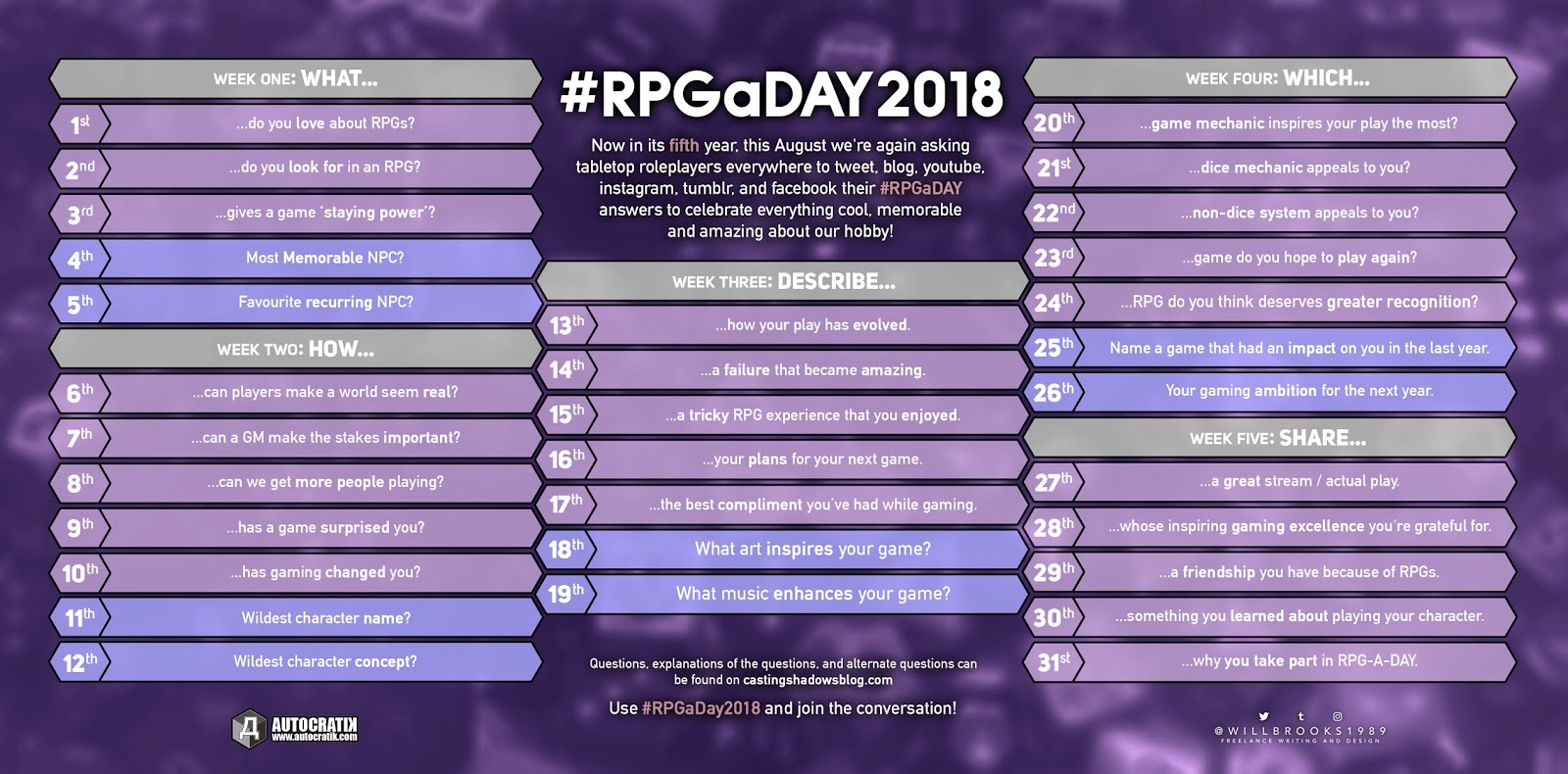
This week’s questions are all “Describe…”, so I suspect that these might be a bit more involved than the usual short answers.
Today’s question is “Describe how your play has evolved.”
I’ve been playing for nearly 40 years now, so to go into detail on that would take far more than I’m willing to expend on this (and would probably only be of interest to me, in any case). That said, I think I can organize my evolution of play into four general ‘eras.’
• The Genre Polymath: As I’ve mentioned before, I started with TOP SECRET, and six months later, D&D. Over the next few years, I devoured any RPG that I came across — I bought and read more games than I ever managed to play — and I played a lot. STAR FRONTIERS, GAMMA WORLD, BOOT HILL, TRAVELLER, MARVEL SUPER-HEROES, UNIVERSE, DAWN PATROL, etc. When I did play, we stuck to the rules as written — no fudging of die rolls, no real consideration of story over mechanics, etc.
• The Emulator: It’s pretty easy to mark the start date for this ‘era’ — 1983, with the release of Victory Games’ JAMES BOND 007, a game that opened my eyes to the fact that rules could be designed to be more than just mathematical resolution of events, but could actually be designed to emulate the feel of a genre. I found myself drawn to systems that took this approach, and my games began to emphasize the tone and trappings of a setting far more than before. Other games I played during this period were FASA’s STAR TREK and DOCTOR WHO, Chaosium’s CALL OF CTHULHU, and I brought the lessons of emulation back with me into games I’d played in a less-emulative fashion previously.
• The Storyteller: This is more of a culmination of the above ‘era” — with the arrival of VAMPIRE: THE MASQUERADE, I discovered an entirely new method of play that emphasized the story that was being collaboratively created through the play experience. Dramatic techniques crept into play, across the board — not just in storytelling-focused games. I began to use lighting and music to enhance game experiences, and started to play in comfortable surroundings, rather than via the typical “game table” environment. It was during this period that I started designing games professionally.
• The Collaborator: This is the ‘era’ I find myself in now. A realization over the past decade and a half that the play experience is enriched (for both players and GM) when the work is shared. Things that previously I would have considered the purview of the GM, especially worldbuilding, I find more rewarding to spread out among the playing group. Collaborative creation not only of the story being told, but of the larger world in which the story takes place. Players taking traditional GM roles in the creation of narrative elements which are then folded into the ‘reality’ of the game — that’s what appeals to me now. From on-the-fly NPC creation by the player declaring that they “know a guy,” to developing backstories of inter-character relationships that create setting elements and plot hooks to be brought into play — that’s what I like to have now, and I bring all of these elements into every game I play (and design, for that matter). I still read WAY more games than I play, but when I do now, it’s with an eye towards system elements which scratch that itch, which I examine to see if they can be imported whole into other games.
So yeah. This is WAY longer than I intended, so I’ll leave it there. Back to work! I’ve got games to design.