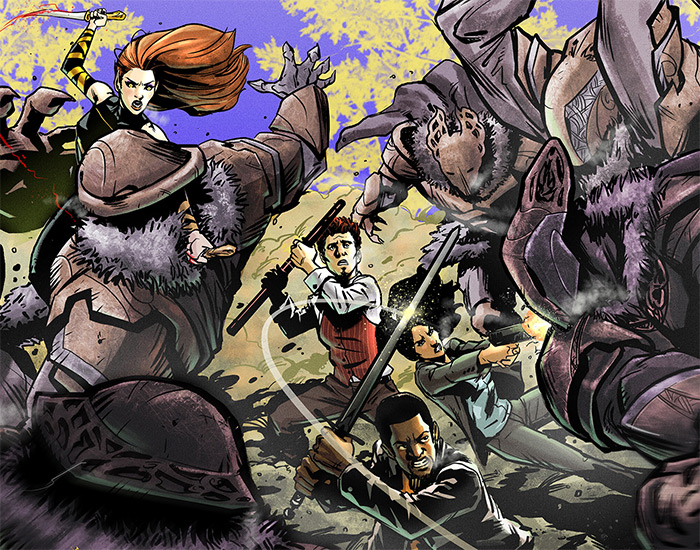
My friend John Rogers has debuted his new comic series, ARCANUM, over on Thrillbent, the digital comics site he started with Mark Waid. Episodes will appear on Mondays, for free — viewable on the website, or downloadable as PDF or CBZ formats… and, as a new function, embeddable like Youtube videos:
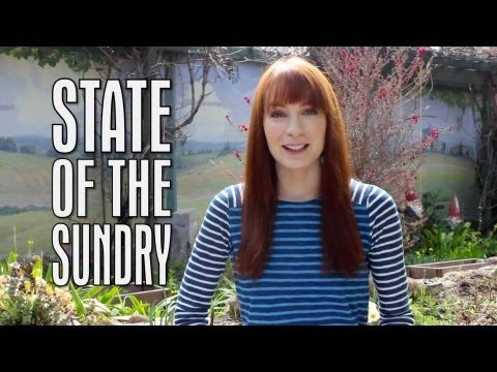
Recently, Felicia Day posted a video outlining her plans for a second series of shows for her Youtube channel, Geek & Sundry. If you haven’t already seen it, take a few minutes to watch, above.
I’ve been mulling over this for a few days now, because the whole “we need to re-own the word Geek” part of it really kinda rubs me the wrong way. I hemmed and hawed about unpacking that in any really public way, knowing that this would have me seen as publicly being “against” Felicia Day, a monolithically popular figure in online geek circles. But I found that I was genuinely curious if it was just me, or if other people felt the same.
The whole angle strikes me as very similar, ironically, to the whole “fake geek girl” outrage. The idea that there are “Real” geeks — by definition — who need to somehow “take back” the term, away from the non-genuine users, who only use it as a marketing label; a category by which consumers are classified.
I’m sorry — but Geeks aren’t Rebels. Some are, sure. But despite the protestations in the video, Geeks have pretty much *always* been defined by their entertainment fandom — and it was their love of those things that made some of them outcasts, as the “popular kids” ostracized them. What came first, the chicken or the egg? The nerdy love of comic books and Star Trek, or the outsider status that came with that love? But to claim that it is the Outsider, the Rebel, etc. that marks the “true” geek is uncomfortably close to the cries of the guys who are bitching that attractive girls can’t been geeks because they didn’t “suffer for it.”
Another thing: the idea that “Geek” is being commodified by some outsider group (especially ironic coming from somebody trying to market videos to the same audience) is a massive ball of hipster bullshit. Geek is mainstream because geeks are now in positions where they are creating and decision-making in entertainment — they’re producing stuff that interests them, which is attracting the like-minded. Combine that with the aggregating and communication ability of the internet, and it means that what might be a small subculture in a particular school or town is suddenly and inescapably seen as a fairly large national (hell, global) interest group.
…and let us not forget that geek stuff has always been popular, sometimes massively so (Star Wars, anyone?). The main difference is now people are comfortable with identifying with the label. (Everybody loved Star Wars in 77/78, but few would’ve called themselves “geeks.”)
Geek is about loving stuff, and sharing those interests with others. It doesn’t matter if you came to it early, suffered through bullying because of it, or just walked into it yesterday because you played “Bioshock Infinite” and really dug it. It’s all good, and the tribalist crap of “re-owning” the word, of attempting to define what makes a “real” geek, is really disappointing, especially coming from a high-profile person whom many view as an ambassador of the culture.
I got back yesterday from PAXEast in Boston, my first time at that show. Aside from staying a day later than planned thanks to Delta Airlines (DELTA: Doesn’t Ever Leave The Airport), the trip was great.
So, for this post, I’m returning to a long-held tradition of mine: To recap some of the things said or heard at the show, via context-free quotes.
“I’ve got some kind of magical animal.”
“You could park a zeppelin in here.”
“What could be better than dough?”
“The Walking Poor.”
“Sexy Foreign Guy Is Here For Your Womens.”
“This is my sister. She sang that Madonna song.”
“Occasions!”
“I tend to talk faster and get much more Welsh.”
“Enjoy your artisanal sandwich… it’s rustic. Says so on the plastic.”
“We’ve made the stretch goal! Everyone eats!”
“I think we need a Nemesis.”
As an aside — it is definitely a show worth attending for tabletop games companies. The population concentration in the northeast alone means that you’ll be seeing more traffic than you get at GenCon, even if the tabletop area is secondary to the main expo hall area.
Oh, and another thing you should be aware of: The tabletop exhibitor area runs around the open-gaming and tournament tables — which stay open until 2am — and there’s no separation. So even though expo hall ‘closes’ at 6, that’s not the case in tabletop, as people still come through. We’d wrap up around 9ish (3 hours after ‘close’), but could’ve stayed there the whole time… if we wanted to work a 16-hour day. Worth keeping in mind when considering staffing.