
Friday Music

As I head into the long slog of the holiday season, where my schedule is filled to the brim with family plans and deadlines alike, I find myself returning to my blog — oddly, I tend not to blog a lot when my schedule is open, but something about the mindset I’m in when my schedule is full prompts additional work.

So, Friday Music: A glimpse at what’s been rattling around in my head as I work on other things.

First up — Florence + The Machine have a new album, Ceremonials, which has been on constantly play for me since its release (slightly before its release, in fact). I’ve fallen for this album hard — and the truly amazing thing about it is that it didn’t find its way into a single playlist for a particular project of mine (as is usually the case — some albums are more suited to FAR WEST, others to Vesper Nova, etc.). As I listen to Ceremonials, however, in the mindset of one project or another, I find it shifting, adapting itself to what I’m thinking about. I see connections. Very cool. My favorite track on the album: Florence + The Machine – “Seven Devils.”

I caught the recent film Red Riding Hood via Netflix — which was OK. Not great, but not awful. The music, though, was pretty cool. A number of tracks on the soundtrack were done by Fever Ray, which is the side project of Karin Dreijer Andersson of the Swedish electronic duo The Knife (who I’ve been a fan of for years — long-time Friday Music readers will remember my discovery of them via “Silent Shout”). Here is one of those tracks: Fever Ray – “The Wolf.”

Here’s a track specifically for my friend Tessa Gratton whose new alt-history YA series, Songs of New Asgard was announced by Random House this week. Týr is a folk-metal group from the Faroe Islands — and their album Eric The Red is full of Viking-y goodness, including several tracks based on traditional Faroese folk songs, and sung in that language (an insular form of Old West Norse that still survives, spoken by about 50K people). If you want to hear what popular music probably sounds like in New Asgard, this is probably close! This is a track about a Smith named Regin: Týr – “Regin Smiður.”

Shifting gears, here’s a track from the latest M83 album, which is currently being used as the backing track to the Holiday 2011 Victoria’s Secret commercials. Retro-synthpop alternative sounds, plus lingerie models with angel wings? Yes, please. M83 – “Midnight City.”

Stumbled across this on the radio of all places — hadn’t heard it in years. This was their first single in 1985 — and a Ska-funk-soul-punk mix of politics, social-consciousness and diversity was right up my alley, having just discovered second-wave Ska from the UK a couple of years previous. Fishbone – “Party at Ground Zero.”

This is getting a lot of airplay now (and I tend not to focus attention on stuff you can hear everywhere), but I really like it, so here it is. This is, as my teenage daughter says, “the most cheerfully catchy song about a school shooting EVER.” Foster The People – “Pumped Up Kicks.”

There ya go, kids. Enjoy.
Made on a Mac

The internet is filled with remembrance of Steve Jobs since the announcement of his death from pancreatic cancer yesterday. I posted on Twitter when I heard, but despite my intention not to join the flood of content about Jobs today, I found myself dwelling over the past 24 hours on just how much my life was affected by his work. It felt somehow churlish not to recognize it publicly.

That graphic up there: “Made on a Mac.” That’s pretty much my career.

My first home computer was a used Apple II — where, between bouts of Bilestoad, I did my first non-longhand writing. I went on from there to an Apple IIc, bought second-hand from a friend in 1990. More writing, and moving into graphic design and art. In the early-t0-mid-90s, I dabbled in Amiga and then in Windows-based PC — as I moved out onto the burgeoning internet and into the birth of the world wide web (whose code was written by Tim Berners-Lee on a NeXTcube, created by the company that Steve Jobs launched when he left Apple). Yet even through this dabbling, I continued to use Macs — at school, and with friends.

It was a Mac that provided the desktop publishing tools that allowed Aaron Rosenberg, Matt Harrop and I to produce our first RPG, Periphery, clustered around the Mac in Aaron’s bedroom. In the late 90s, I used Pagemaker (a program I had learned on the Mac) on my Windows machine to do graphic design and layout for other games — Hong Kong Action Theatre!, for example. The program was the same, but I never really liked the not-quite-right feeling of its use on my PC.

In 2000, I returned to Apple — and haven’t left since. Synister Creative Systems was run on Macs — G4 PowerMac with dual monitors as the graphic design desktop , and a blueberry iBook for me, able to be used in-office or remotely. Jobs was back at Apple, and the iMac and iBook were the first products in his new vision for the company. A vision that, as the Colorado Springs Gazette said today, liberated the creative class.

I am a part of that creative class. I create on products spearheaded by Jobs, that are consumed on products either spearheaded by Jobs or products emulating those he spearheaded. I reach my audience directly, via a world-wide network that was created on a product spearheaded by Jobs.

I owe the man a debt that is staggering in its scope. My life, my career, my calling — all of it:

Made on a Mac.

Who Knows What Evil Lurks…

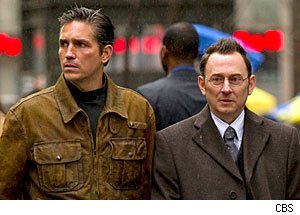
So last night, Laura and I caught up on the first two episodes of Person of Interest, and I’ve gotta tell ya: It’s one of the best modern takes on The Shadow that I’ve ever seen.

No, seriously.

The original pulp tales of The Shadow featured a mysterious character (a cipher, really), supported by a network of operatives and contacts, fighting crime in New York City. Eventually, we learn that The Shadow is Lamont Cranston, a wealthy socialite… but wait! Later we learn that there’s a real Lamont Cranston, and he’s just another of The Shadow’s assistants, and that The Shadow is *actually* Kent Allard, a WWI aviator and soldier-of-fortune. I’m sure had the pulps continued, we would’ve eventually learned of another identity, behind that one.

Person of Interest takes the archetype and runs with this idea: what if the hero was actually a combination of people? To put it in terms of The Shadow, what if he was actually just the network of operatives?

Person of Interest features two cipher characters — one brains, one body. The brains are embodied by a mysterious genius who calls himself Finch — a multi-billionaire software genius now apparently presumed dead (who does things like work as a lowly coder at one of the many companies he founded). The body is Reese (“You’ve had many names. You seem to prefer that one.”) — a former CIA black-ops agent, apparently also presumed dead.

Finch built a machine for the US government, post 9/11 — an Echelon on steroids. It monitors all telecommunications, watches everything via networking all CCTV cameras, facial recognition, etc. Its task was to spot malicious intent — to stop terrorist attacks *before* they happen. After years of development, Finch realized that it was discovering ALL malicious intent — murders, etc. The government made him put in a program which separated relevant (national security) criminal activity from the rest, which they deemed “irrelevant.” The irrelevant data would be erased from the system every night at midnight.

Finch couldn’t live with that, and so he built a back-door into the system. He knew that if he was caught, they’d shut it down — so now the machine sends out 9 digits before erasing all of the ‘irrelevants.’ Only 9 digits — a single social security number. That person is somehow involved with a crime that is being predicted — although how they’re involved and what the crime will be is unknown.

Finch hires Reese to be the body to his brain. Finch funds everything, provides intelligence support, and Reese does the “hero stuff” — tracking down the person, investigating what’s happening, and trying to stop the crime before it occurs. He uses contacts as well — other people that they’ve encountered along the way (very much like The Shadow, again).

Gotta tell ya — I’m hooked. The machine is hand-wavy, yes — but who cares. It’s a clear concept. Uber-Big-Brother-Surveillance gives us one person who is in a dangerous situation — go fix it. A great dramatic premise. Plus, the surveillance-graphics which permeate cut-scenes and such is really well done. The whole “finding meaning in meaningless patterns” angle is cool.

As Laura said while we were watching the premiere: “It’s like Rubicon, but with stuff actually happening!”

For me, it is another clear indication that pulp tropes absolutely do not have to be contained within a period piece to succeed.