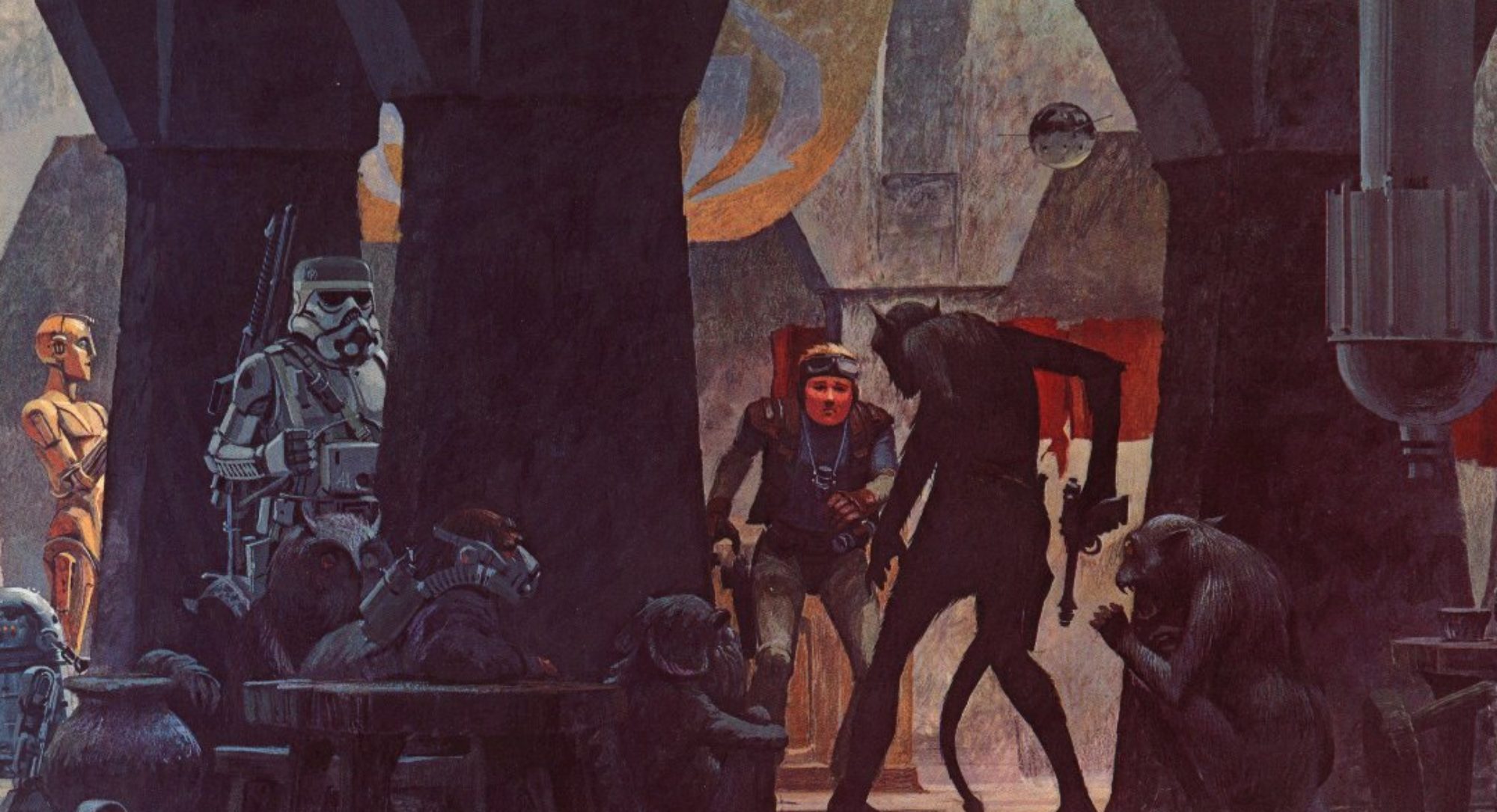

The Greatest Space-Fantasy of All Time!

Part of it, I’m sure, is that I’m now in my 40s.

Part of it is reminiscences like James Maliszewski’s recent run of entries on his blog, “Grognardia” (start from that date, and go forward from there, he’s done a few), or the always-excellent Space:1970 blog.

I’ve been thinking a lot about the stuff that I *lived for* from roughly Age 8 until my teenage years (when things like music and girls distracted me).

The fire was lit, certainly, by Star Trek re-runs in the early-to-mid 70s. But, like most geeks of my age, the conflagration took off in 1977, with Star Wars, and nothing after that was ever the same.

So yeah — I’ve been thinking a lot about that time, especially the years from 1977 through 1980 — when the first film was all that there was, when the horizon was endless, and the galaxy hadn’t been defined down to the last name and backstory given to every minor walk-on in a scene. Thinking about my imaginative diet at the time — the thing that consumed me, from reading to watching to drawing to playing.

I’ve come to the realization that I’m not really a Science Fiction fan.

I’m a fan of SPACE FANTASY.

That actually used to be a branding description for Star Wars — the Marvel comics used to occasionally have a bannerhead that proclaimed “The Greatest Space-Fantasy of All Time!” That terminology eventually faded from view, of course, as Lucas retroactively tried to convince us all that what he was *really* doing all along was a Campbellian Hero-Myth Exploration. Very Serious, you see. Not just a tribute to the far-flung Flash Gordon serials of his youth, when he couldn’t get the License from King Features. No sir.

I love Space Fantasy. I want giant space-cruisers. I want soaring spacefighters wheeling and roaring unscientifically. I want jungle-planets, desert-planets, ice-planets. I want floating cities. I want knights and knaves and princesses and kings and queens and wizards and monsters… But I want them with lasers.

I want GRAND EPIC HEROISM AND SCALE, not speculation on possibility.

So, dear reader — feed the monkey on my back. I’ve got plenty of filmed entertainment to choose from, but what I’m lacking is stuff to read. What are some of your favorite Space Fantasies?

Burning Need: A Counter-Protest

UPDATE: It’s now breaking that the nutjobs in Florida have agreed to cancel their book-burning — with some language about an apparent quid-pro-quo with the group behind the Park 51 Center agreeing to move their location, despite denials of that claim from Imam Rauf — but I’m still leaving this open. I feel that the donation to Islamic Relief USA is still merited, not just to send a message about our true values, but also because of the need for aid in Pakistan. Please feel free to join me.

By now, you’re all familiar with the story. Terry Jones, the pastor of a tiny Florida church, has garnered worldwide attention for his plan to burn more than 200 copies of the Qur’an on September 11th, 2010.

Despite universal calls for these extremists to cancel their event, Jones says that his hateful display will go on. Opposition to this event among US politicians is absolutely united and bi-partisan, with everyone from Sarah Palin to President Obama agreeing that it is counter to American ideals. Yet these small-minded fanatics are bound and determined to go ahead with their disgusting display of hatred.

So I’ve decided to do something about it.

Taking a page from the outdoor clothing company Patagonia, who in 1990 fended off anti-abortion protesters by donating money to Planned Parenthood for every person who picketed, I’ve decided to turn the extremists’ own actions against their goal.

They plan to burn 200 copies of the Qur’an. So I’ve decided that I will donate 1 dollar for each book they burn to Islamic Relief USA, to aid (among other things) relief for the flooding in Pakistan. I will make this donation on Friday, October 1st.

If you would like to add your voice to mine, please feel free to donate in any amount, no matter how small, via the button below. I will update this page regularly with the total raised to date, and on October 1st will deliver the total to Islamic Relief USA, in the name of all of us actually believe in the ideals of brotherhood and respect.


Tour de Bond: Live and Let Die (1954)

I’ll be honest with you up front about this: Live and Let Die is one of three Bond novels that I just don’t like (the other two being Diamonds Are Forever and The Spy Who Loved Me). The main reason for my dislike in this case is the casual racism of the book.

I usually have a fairly high tolerance for this sort of thing — I recognize that books are the products of their times, and a book written by an upper-class Englishman in the early 1950s is not going to have a particularly enlightened view regarding other races. Hell, I absolutely *love* the Fu Manchu novels of Sax Rohmer, and those have had a bad reputation for racism for decades now (in their presentation of the “yellow peril” — although I’d strongly argue that the books aren’t remotely as racist as their reputation suggests.) In fact, in many ways, Fleming is working a bit of a Fu Manchu pastiche with Live and Let Die — A “black peril,” if you will. The villain, Mr. Big, is a mastermind in the Fu Manchu tradition, and the omnipresent threat that ANY member of the race met in the story could be a member of the villain’s network is certainly plucked from the Rohmer novels.

So why does it bother me more in Live and Let Die? Not sure. Perhaps it’s that I’m more familiar with African Americans than I am with Manchurian Chinese — making portrayals of them as a mysterious “other” much more jarring to me. Perhaps, as an American raised in the post-Civil-Rights era, it strikes me as horrifying to have a chapter in this novel given the title “Nigger Heaven” (even if I know intellectually that the title is a reference to the 1926 novel set in the Harlem Renaissance). I can forgive references to “negresses”, since that was a perfectly acceptable word choice for an Englishman of his time… but I find it far harder to stomach references to them being “feral.” For all of these reasons, I find the book not just dated, but… ugly.

As a side note, I find it interesting that the three books I mention as my least favorite of the Bonds all take place largely within the United States. Maybe I want more exotic locations in my Bonds. Although, certainly, to Fleming (and to his UK readers) the US certainly qualified. Fleming’s view of the US certainly wasn’t flattering — his descriptions of the South as Bond heads from Harlem to Florida certainly echo my impressions from the time I spent living in Atlanta: The sense of decay that lingers through the oppressive heat, for example, matching the sense of a declining (and at times equally-oppressive) culture.

There are some good points to the novel — Fleming’s pacing is still in evidence here. Not perhaps as tense as Casino Royale, but it moves even faster, because he now takes the reader’s familiarity with Bond as a given, and just throws us into the tale. The book also features one of the more iconic bits of Fleming mayhem — Mr. Big’s henchman “The Robber” feeds Felix Leiter to a shark — when Felix is dumped at the safe house, barely alive and missing an arm and a leg, he has a note pinned to him that says “He Disagreed With Something That Ate Him.”

Moving on, then. Next week: Moonraker (1955).