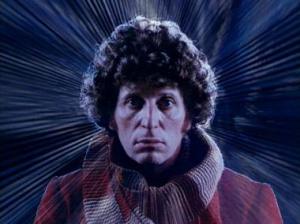
 My favorite television show is older than I am. I’m a bit of a Johnny-Come-Lately — when I started watching Doctor Who, it had already been on the air for a dozen years. A baker’s dozen, in fact — appropriate, since when I first saw the show, in the bicentennial year of 1976, Tom Baker was portraying the Fourth Doctor. I was living in upstate New York, and this was before the widespread import of the show into America, via Public Television stations, which would occur across the country in 1978-79. No, one of the local UHF stations would show 2 episodes back-to-back on Sunday mornings, part of the Time-Life television syndication package — complete with awful voice-overs from Howard DeSilva over the beginning of each episode, explaining the strange goings-on to my fellow benighted colonials.
The first thing that I remember was the title sequence, like nothing I’d seen before. Strange streaming patterns of energy, the staring, unsmiling face of a man, and an ornate title logo that looked like stained glass, all accompanied by this eerie music: haunting, howling, urgent. It scared me more than a little bit — but not the kind of fright that made me turn away. (In later years, in fact, this reaction would be shared by my oldest daughter, who, as a toddler, would shout out “SCARY MUSIC!” whenever she heard the theme.)
The first episode that I clearly remember watching was “The Pyramids of Mars” — still my favorite Doctor Who story of all time, a mix of H.G. Wells and Hammer-horror Egyptology. I was, quite simply, hooked.
The show has been a constant in my life ever since. One of the first short stories I ever wrote featured a Krynoid (from “The Seeds of Doom”). My first TV-star crush was Elisabeth Sladen, who portrayed the Doctor’s companion, Sarah Jane Smith. When my parents told me, at age 14, that we’d be moving to Kansas, I was in my room, watching Episode 3 of “The Pyramids of Mars” on a beat-up old black-and-white set with rabbit ears. I met my best friend during a high school chemistry class, when he noticed that I was reading a copy of Doctor Who Magazine. Watching Doctor Who and playing the RPG published by FASA filled weekends and summers through high school and into college. The night my first child was born, “The Pirate Planet” was playing on a hospital TV.
During the period of from 1989 to 2005, even when there was no new Who to watch (aside from the 1996 Fox-produced TV pilot), there was still more Who to be had — novels featuring the most recent Doctors (Sylvester McCoy’s 7th, before the TV movie, Paul McGann’s 8th afterward) kept the adventure going. Novels featuring earlier Doctors filled in gaps in the past. At the turn of the century, when I was living in New York City, new dramatic performances featuring past Doctors, produced by Big Finish as audio plays, accompanied me on endless subway rides.
Then the show came back… and impossibly, became a global hit. Doctor Who was on TV again — everywhere. The show had a big budget, and the same wonderful writing that has always been its core. Christopher Eccleston’s war-wounded lonely 9th Doctor gave way (too soon — I still want more) to David Tennant’s hipster genius geek 10th Doctor, who began to rival the 4th as my favorite. The 10th became the 11th with Matt Smith, in a top-to-bottom tonal reinvention of the show that played upon the theme of classic fairy tales — wondrous, but with a darkness lurking at the edges.
I then had the opportunity to fulfill a lifelong dream of writing for Doctor Who, when my colleagues at Cubicle 7 Entertainment offered me the chance to produce material for the Adventures in Time and Space role-playing game. (As an aside, I would still love to write for a Big Finish audio, or a Doctor Who novel, so, y’know, if you’re reading this and can make that happen, drop me a line…).
For a nerd of my generation, who used to have to explain why we loved Doctor Who, who were often, dare I say it, embarrassed by our devotion to a show originally intended for children, the newfound popularity of Doctor Who is still something shocking. It still gives me pause to see Doctor Who merchandise in mainstream shops, to see non-outcast kids who love the show, who embrace the ethos of a clever individualist hero, saving the universe with moral authority and without irony. The show has gotten flashier — more streamlined, faster-paced, bigger — but the core of it has not, mercifully, changed. As Craig Ferguson famously said, it remains a show about the triumph of intellect and romance over brute force and cynicism.
Happy 50th, Doctor Who… and thank you.

 One of the projects that I’ve had churning around in the background is a revamped version of ePublishing 101 — a project that Phil Reed and I did some years ago. The original version was very game-industry specific (since the industry was an early adopter of digital publishing), so my plan is to expand the material to account for the current digital publishing boom.
