Back from GenCon — and had a relatively good time. It’s always nice to meet the folks who enjoy your work, and GenCon also serves as a time to socialize with colleagues and friends whom we only see a couple of times a year if we’re lucky. On the professional front, several things came together which have me very excited, and I am finally now an Ennie-Award-winning game designer, having a 1/12th share of the one given to DOCTOR WHO: ADVENTURES IN TIME AND SPACE (11th Doctor Edition) for “Best Family Game.”
But this post isn’t about the good stuff. It’s about the very bad.
Belle and Blade (no, I’m not going to link to their site. I won’t give them the traffic.) is a fairly notorious vendor at GenCon. Officially, they focus on “military interest DVDs” — the booth is filled with copies of The Longest Day, Midway, Saving Private Ryan, The Four Feathers, Zulu, that kind of thing. Of course, if you look a bit closer, you’ll also find such gems as Ilsa, She-Devil of the SS, Red Nights of the Gestapo and Stalag Bitch. The Nazi fetishism continues on the inside of the booth, where you can find Triumph of the Will and T-Shirts emblazoned with each of the SS Division insignias, “Afrika Korps World Tour”, and other such gems. They’ve been an embarrassment to the industry for the years they’ve been exhibiting, but, depressingly, it seems a not-insigifiant part of the gamer audience actually gets into that kind of shit.
So I was not surprised when Valerie Laproye of French games publisher 7ieme Cercle was upset on Thursday night, telling me of the Nazi crap she’d seen in the dealer’s hall.
Then she mentioned the panties.
Wait, what?
I was used to the Nazi-fetish bullshit carried by Belle & Blade, so I was surprised when Valerie listed women’s underwear in the litany of the booth’s product — She said they were carrying black underwear, hung at child-height on the outside of the booth, emblazoned with slogans like “I COULD USE A LITTLE SEXUAL HARASSMENT.” She was quite upset by this — and I was as well. I had thought that admiration of the Nazis was as low as this exhibitor could go. I was wrong.
The next morning, I swung by their booth (1622) before the hall opened, and snapped a couple of pictures:
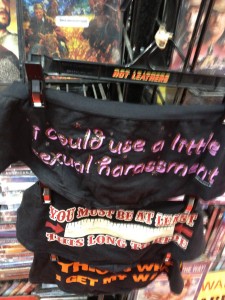
In this shot, you can see the “sexual harassment” panties, above a pair that reads “you must be at least this long to ride” (with a picture of a ruler), and another that says “this is why I get my way.” The next shot I took, though, is where things got even worse:
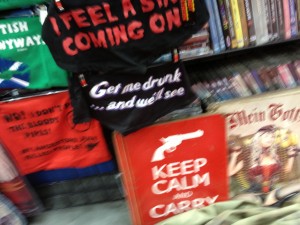
There, in the center, you see a pair emblazoned with the slogan “Get me drunk …and we’ll see.”
Let that one sink in a bit.
I headed over to security, where I showed the pictures to a friend I have on the staff, who was as pissed off as I was. He promised to escalate it further up the chain.
After that, I heard nothing more — things got very busy for me, and I was unable to head back to the other side of the hall to check up on things. On Twitter, more people started expressing shock and outrage. I mentioned it to several colleagues at the show as well. I know that many of these people filed complaints of their own with GenCon.
On Sunday, I heard several reports from friends that the panties were gone — but I’ve also heard via people on Twitter that they’d been only moved inside the booth, to share shelf space with the Nazi fetish bullshit. So far, there has been no official statement of any kind made by GenCon regarding this issue.
GenCon has vendors guidelines, and a clear policy governing harassment, and women’s panties emblazoned with encouragements of harassment and date-rape would seem to be clear violations of these policies. The silence, especially given that complaints began as early as Friday morning, is concerning.
The message that these products, and any action taken (or untaken) regarding them, sends about our industry is a fairly loud one. I will be keeping my ear to the ground for any news regarding this issue, and will pass along anything I discover. I would request that anyone with any further information please add it to the comments below — and also please send your concerns along to GenCon, letting them know how you feel about this vendor and their products.

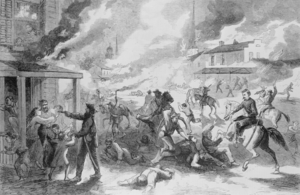 Today is the 150th anniversary of Quantrill’s Raid, when pro-confederate raiders from Missouri burned Lawrence KS & massacred 164 men & boys. To this day, there are memorial stones marking where men & boys were gunned down. One is a block from my house (we live in the Old West Lawrence neighborhood, which was pretty much the entire town back then).