
LATE.

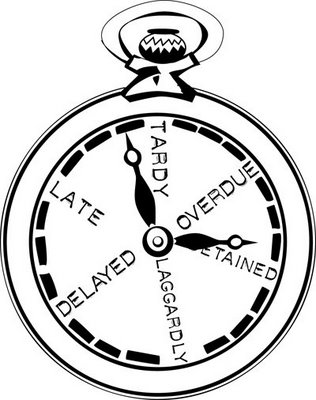
Confession-is-good-for-the-soul time. My biggest professional failing is lateness. I always overestimate how quickly I can get things done, and I’m always doing more than one thing, so once a project falls behind schedule, I’m playing a constant game of catch-up… and the lateness causes a cascade into everything else I’m doing, causing them to be be delayed as well. Next thing I know, I’m left feeling like I’m simultaneously juggling five or six balls while also desperately treading water trying to avoid drowning.

(Yeah, I know — my stress-metaphors don’t fuck around.)

The side effect of the cascade is that I’m constantly working with several projects which are all behind schedule — which makes working on each one that more difficult, due to the peculiarities of how my brain works. Logically, I know that if project A is the latest, I should knock that out until it’s done, and move on to project B, which is less late, then on to C, which is barely late. Somewhere in the misfiring neurons of my stress-addled mind, however, if I try to concentrate on A, then thoughts of B & C intrude, nagging at me almost to the point of panic. “We’re late,” they cry. “You need to get this done!” And so my work on A is like crawling over broken glass (see? I wasn’t kidding about the stress-metaphors). I often end up trying to bounce between projects to shut down the nagging, which of course doesn’t really do anything but slow down the completion process.

This is one of those things where working for yourself puts you at a disadvantage. I’m pretty sure if I had somebody telling me “DO PROJECT A.” I could concentrate purely on that — and then they could point me at the next task. Adamant, however, is a one-man shop, plus freelancers, co-developers, etc. Which means that everything bottlenecks through me, and I’m the guy standing over myself, giving the orders.

The result is 7-day work weeks, filled with 12-16 hour days. I can’t allow myself to unclench, to give myself any down-time, as long as there are projects which need work… and there are always projects which need work. Lack of down-time means that my immune system is stress-weakened, which often results in my getting slammed by whatever bug is going around, which has the added joy of making me feel even worse — and making my work even slower and the projects even later.

So it’s a failure of which I am exceedingly aware.

Folks ping me all the time, though — via social media, email, forums, etc. Fans, for the most part. Enthusiastic. “When is X coming out? Is it out yet? When? How about now? I’m dying over here! Now? Come on!”

On the one hand, I know this is a positive thing. People look forward to the stuff I release. They want it. This is, of course, far better than the alternative — that they don’t care or don’t even notice.

On the other hand, though? A gut-twisting knife, every time. Seriously — actual physical discomfort. A stark reminder of my failing. Massive injections of additional pressure and stress …and I know it’s not intended to be that. It’s genuine interest from genuine fans, and I absolutely hate that my brain has managed to turn that into a negative thing.

So I end up using my lunch break to write out a blog post like this, in the hopes that putting it down in black-and-white will force my mind to stop doing that.

How about you folks? How do you keep from falling behind (or whatever your own personal failing may be)? How do you hack your own brain to stop responding in ways that are detrimental to your work?

Made on a Mac

The internet is filled with remembrance of Steve Jobs since the announcement of his death from pancreatic cancer yesterday. I posted on Twitter when I heard, but despite my intention not to join the flood of content about Jobs today, I found myself dwelling over the past 24 hours on just how much my life was affected by his work. It felt somehow churlish not to recognize it publicly.

That graphic up there: “Made on a Mac.” That’s pretty much my career.

My first home computer was a used Apple II — where, between bouts of Bilestoad, I did my first non-longhand writing. I went on from there to an Apple IIc, bought second-hand from a friend in 1990. More writing, and moving into graphic design and art. In the early-t0-mid-90s, I dabbled in Amiga and then in Windows-based PC — as I moved out onto the burgeoning internet and into the birth of the world wide web (whose code was written by Tim Berners-Lee on a NeXTcube, created by the company that Steve Jobs launched when he left Apple). Yet even through this dabbling, I continued to use Macs — at school, and with friends.

It was a Mac that provided the desktop publishing tools that allowed Aaron Rosenberg, Matt Harrop and I to produce our first RPG, Periphery, clustered around the Mac in Aaron’s bedroom. In the late 90s, I used Pagemaker (a program I had learned on the Mac) on my Windows machine to do graphic design and layout for other games — Hong Kong Action Theatre!, for example. The program was the same, but I never really liked the not-quite-right feeling of its use on my PC.

In 2000, I returned to Apple — and haven’t left since. Synister Creative Systems was run on Macs — G4 PowerMac with dual monitors as the graphic design desktop , and a blueberry iBook for me, able to be used in-office or remotely. Jobs was back at Apple, and the iMac and iBook were the first products in his new vision for the company. A vision that, as the Colorado Springs Gazette said today, liberated the creative class.

I am a part of that creative class. I create on products spearheaded by Jobs, that are consumed on products either spearheaded by Jobs or products emulating those he spearheaded. I reach my audience directly, via a world-wide network that was created on a product spearheaded by Jobs.

I owe the man a debt that is staggering in its scope. My life, my career, my calling — all of it:

Made on a Mac.

Inclusion in RPGs

First off, spreading the Kickstarter love: Heartbreak and Heroines, a fantasy RPG specifically designed (in the words of the author) to be much more inclusive:

Heartbreak & Heroines is first and foremost a fantasy adventure game. It’s not preachy and it isn’t a textbook about feminism, but it’s written from a feminist point of view. It challenges some of our assumptions about the role of gender in gaming but at the heart of H&H, it’s about being a heroine (or hero) and finding your way to happiness in a dangerous world.

I think that this is great, a laudable goal, and also pretty much exactly why Kickstarter exists. Come up with an artistic project concept, tell people about it, and get the project funded if enough people are interested.

So naturally, there is a 200+ message thread on RPGnet, bitching about it. Now, to be fair, most of those messages are in defense of the project (or at the very least “WTF”-ing the detractors) — but still. The “conserva-gamer-libertarian-anti-‘political-correctness’-warrior” stereotype is out in FULL BLOOM, kids. Because making an effort at inclusion? “Extreme.” “Silly.” “Insulting.” “Condescending.”

I pledged just because they pissed me off. I want to see this game funded because it will stick in their craw like the ashes of defeat.

When the thread started, I saw that the designer had only raised $300 or so. She’s asking for $3K. I’m pleased to report that it’s almost to $1K now, less than a day later — and the Kickstarter runs for another 29 days. So please, consider chucking a pledge their way.

Couple of things:

1st, it seems that the original poster also has a problem with what he calls “the Kickstarter Gold-Rush” — I’ve seen him bitch elsewhere, terming it “the money-grab”, etc. The less-socialized corners of the geek community has always had a problem with people obviously enjoying something that they don’t, and therefore railing against it with as much vitriol as they can muster. Kickstarter must really push that button even harder, because the enjoyment of others now has a visible dollar-value tagged to it, making it more of an incitement to rage to these folks.

To which I say: Fuck you, grow up.

People like things you don’t, and sometimes they ‘like’ with money. Nothing to bitch about here (without waving the “I have problems with mature interactions in public” flag wildly, at least).

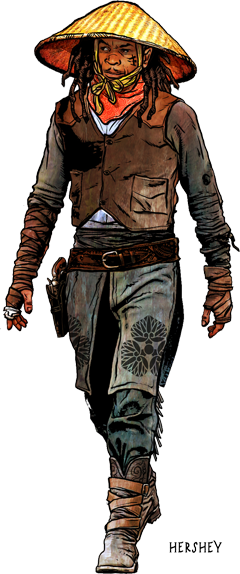
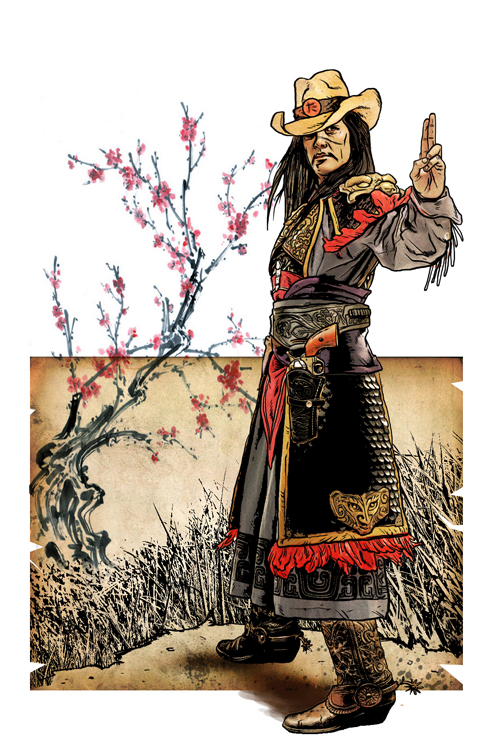
Second: Inclusion? Important. Just as important to those of us who have chosen not to make it an explicitly-stated mission statement of a project, in fact. I draw your attention to the artwork that we’ve presented from Far West:


We didn’t come right out and say it. We were sneaky. But everything we’ve done, we’ve done for a reason.

(So I guess now the Usual Suspects will grouse about our ‘political correctness’ and give us an upward spike in pledges, too!)